


Guru Mahjong
Sophun Games Limited
I approached Guru Mahjong as a quiet, pick-up-and-play board game rather than something designed to keep me constantly busy. It is a free mahjong solitaire game from Sophun Games Limited, built around matching tiles in the familiar single-player format. After spending time with it, my main question was not whether it understands the basic rules—it does—but whether its particular presentation and pace suit the way you want to play.
That distinction matters because “mahjong” can mean several very different experiences on mobile. Some games focus on fast rounds, some on elaborate themes, and others try to recreate a more traditional tabletop atmosphere. This one is best judged as a straightforward tile-matching option for short sessions, gentle concentration, and players who want the classic puzzle idea without needing to learn a complicated system first.
How I would decide whether it belongs on your phone
The core experience is easy to understand
The central loop is simple: look across the board, identify matching exposed tiles, and remove them in pairs. That makes the first few minutes accessible even if you have never played a digital mahjong solitaire game. The challenge comes from choosing carefully rather than tapping as quickly as possible. A pair may be available now, but removing it can reveal fewer useful choices later, so every move has a small planning consequence.
I like that this format gives the game a calm rhythm. There is no need to coordinate with other players, memorize a large rulebook, or commit to a long campaign before the puzzle makes sense. You can open it, play for a while, and stop when your attention moves elsewhere. For me, that makes it more suitable for a short break than for an evening when I want a deep strategy game.
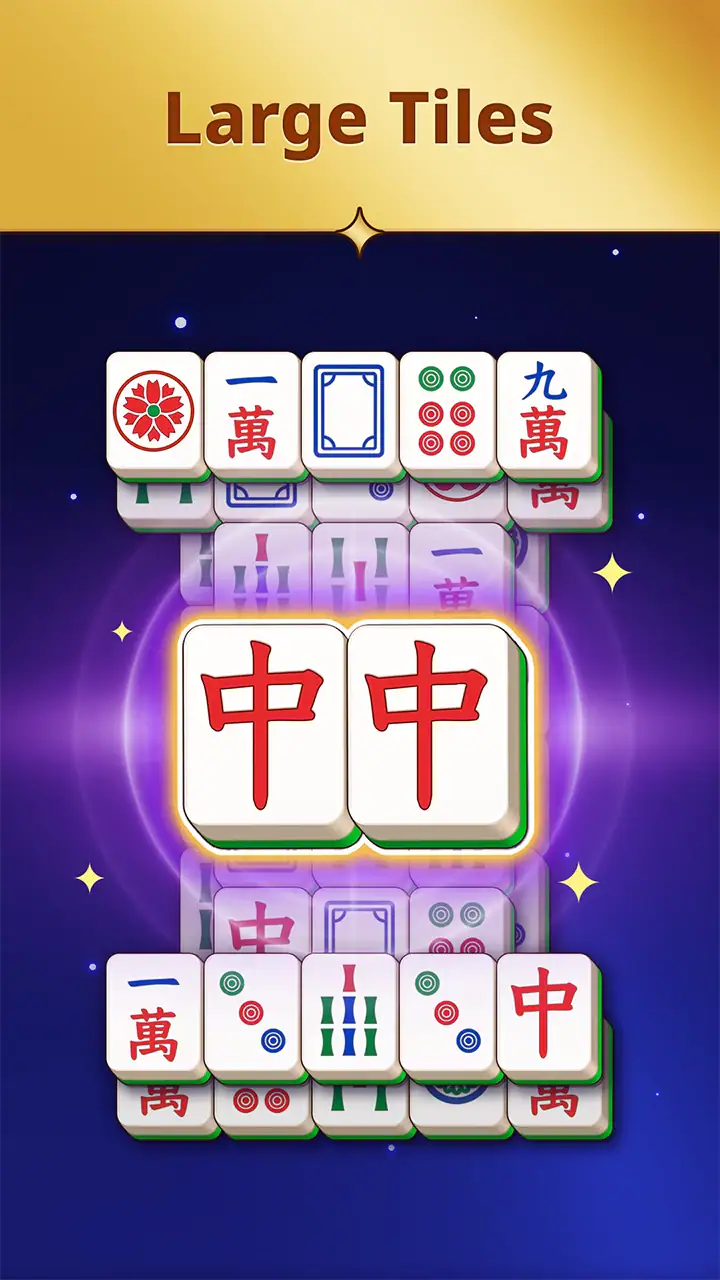
The large-tile approach is particularly important here. Mahjong boards can become visually crowded when symbols are small or layered tightly together. Larger tiles make the board easier to scan, which is useful when I am playing on a smaller phone or when I do not want to strain to distinguish similar markings. It also reduces the feeling that the game is testing my eyesight instead of my decisions.
Related News






What makes a good session
I found the best sessions came when I treated each board as a small planning exercise. Rather than immediately matching the first obvious pair, I looked for tiles that were blocking several others. Removing those early can open more of the layout and reduce the chance of reaching a position with only awkward choices. This is a modest but meaningful shift: the game rewards awareness of the board, not just recognition of identical symbols.
A useful habit is to scan both sides of the layout before committing to a match. If two pairs are available, I usually prefer the one that exposes a buried tile or clears a wider section. That approach is more reliable than playing from the top-left corner across the board. It also gives the otherwise familiar matching loop a little more thought, especially for players who enjoy puzzles that are relaxed but not entirely automatic.
Another practical tip is to slow down after a large section opens. Newly available tiles can create several tempting matches, and taking the first one I notice is not always the best choice. A brief scan of the remaining blockers often prevents me from using a flexible tile when a more restrictive pair would have been better. This is the kind of small decision that makes the game feel more engaging over repeated sessions.
Gallery
Who will appreciate the design
I would recommend this style of game to people who enjoy visual sorting, pattern recognition, and low-pressure puzzles. It can work well for a commuter waiting between connections, a parent looking for a quiet game during a short pause, or anyone who prefers a screen activity that does not demand constant sound or rapid reactions. The Everyone content rating also makes it approachable for a broad audience.
It is especially suitable if you already know that you like solitaire-style board puzzles. The rules are familiar enough to start immediately, while the tile layout gives you something to study rather than simply repeating a card sequence. If you enjoy the satisfaction of clearing a cluttered arrangement one careful pair at a time, the format has an appealing tactile logic even when played entirely on a touchscreen.
I would be more cautious recommending it to someone searching for social competition, a story-driven adventure, or a highly varied strategy system. This is a solo board game, and its appeal depends on whether repeating tile-matching puzzles sounds relaxing rather than predictable. Players who need constant novelty may find the basic structure too narrow, even if they enjoy the first few boards.
Where Guru Mahjong feels strongest, and where another choice may fit better
The advantage of a focused tile-matching game
The clearest strength is focus. The game does not need a complicated premise to explain why I should play one more board. Its entire purpose is to let me concentrate on the arrangement in front of me. That makes it easier to use as a mental reset: I can move from work or a noisy environment into a contained visual problem without learning new controls.
The large tiles also support that focused feeling. They make the board more readable and help keep the activity comfortable during casual play. In a category where tiny symbols and dense layouts can quickly become frustrating, readability is not merely cosmetic. It affects how much of the challenge comes from planning and how much comes from trying to identify what is actually on the screen.
Its broad adoption is reflected in an average rating of 4.8 from around 29 thousand ratings, with roughly 1.1 thousand written reviews. I would not treat those figures as a substitute for my own preferences, but they do suggest that the straightforward structure has connected with many players. The game has also passed 100 thousand installs, so it is not an obscure experiment with no established audience.
For a free game, that combination makes it easy to try without much commitment. I can see why someone would keep it installed as a dependable puzzle for spare moments. The appeal is not that it reinvents mahjong solitaire; it is that it presents the familiar idea in a way that is easy to approach and comfortable to revisit.
The everyday scenario where it makes sense
Imagine having ten minutes before an appointment. A competitive multiplayer game may be a poor fit because a match could run longer than expected or require your attention at exactly the wrong moment. A story game may also be inconvenient if you are about to stop at any time. A board-clearing puzzle is more forgiving. I can begin a session, make a few deliberate moves, and put the phone away when my time is up without feeling that I have abandoned a team or interrupted a narrative.
The same applies to an evening wind-down. I would not choose it when I want excitement, but I might choose it after a demanding day when I want a simple task that still engages my eyes and memory. The key is to use it as a calm activity rather than expecting it to provide the variety of a large game collection.
Where alternatives may be the better decision
Compared with competitive mahjong apps, this is the better fit only if you want solitary tile matching. Competitive versions can offer interaction, pressure, and the satisfaction of reading another person’s choices. Guru Mahjong is not the choice I would make for that purpose. Its value is the absence of social pressure, not a substitute for it.
Compared with traditional card solitaire, the difference is mainly visual and spatial. Card solitaire often emphasizes sequences, suits, and managing a stack of known rules. Mahjong solitaire asks me to inspect a broader arrangement and think about which removal will open the board. If you prefer numerical ordering and predictable card patterns, a card game may feel more natural. If you prefer symbols and spatial clearing, this one has the stronger fit.
Compared with elaborate puzzle games, it offers less thematic variety and less narrative motivation. That can be a benefit when I want a clean, quiet session, but it can also feel limited when I am looking for changing mechanics or a sense of progression. I would choose a more feature-heavy puzzle game for a long-term hobby if I knew I needed frequent new systems to stay interested.
There is also a trade-off between accessibility and depth. The approachable rules make it easy for almost anyone to start, but they also mean the game does not have the layered strategic complexity of a dedicated strategy title. Someone who wants resource management, branching decisions, or multiplayer tactics should look elsewhere rather than expecting the tile board to grow into a different genre.
Things to consider before installing
The game is free to download, which lowers the barrier to trying it. It includes in-app purchases ranging from $0.99 to $79.99 per item. That spread is worth keeping in mind before spending, particularly if you are comfortable with the free experience and have no reason to add optional purchases. I would approach the purchase system deliberately: play first, decide whether the game genuinely earns a place in your routine, and only then consider paying for anything.
The device requirement is also practical to check. The current version is 1.15.0 and requires at least Android 8.1. For many users that will not be a problem, but older phones may not meet the requirement. I would check the operating system before planning to install it on a spare or family device, especially if that device has been kept for basic tasks rather than regularly updated.
The release date is Jul 8, 2025, so the app is relatively recent. That gives it a current feel, but it also means I would judge it primarily by the experience available now rather than assuming a long history of established systems. Sophun Games Limited has kept the concept clear: a board game centered on matching tiles, not an all-purpose entertainment app.
The real cost of switching from another mahjong game
If you already play another mahjong solitaire title, moving over is easy at the rules level. You do not need to relearn the basic objective, and the familiar pair-matching structure means you can evaluate the new game almost immediately. The bigger adjustment is personal: you may need to decide whether the larger presentation and focused style feel better than the themes, layouts, or extras you are used to elsewhere.
I would not uninstall a favorite alternative on the first try. Instead, I would keep both for a few days and use each for a different purpose. Use the existing game when you want its particular atmosphere or features, and use this one when you want a clean, readable board. That comparison is more useful than judging from a single short session because the strengths of a quiet puzzle often become clearer after it has become part of a routine.
There is little reason to switch if your current app already gives you exactly the board style and pace you want. Switching makes more sense when your present game feels cluttered, difficult to read, too competitive, or overloaded with distractions. The large-tile presentation can be a meaningful improvement for those players, but it is not automatically a reason for everyone to change.
My recommendation for different kinds of players
I recommend Guru Mahjong to anyone who wants a free, approachable board puzzle for solo play and values readable tile layouts over spectacle. It is a good match for short breaks, quiet evenings, and players who enjoy making small decisions about what to clear next. The Everyone rating supports its broad accessibility, and the familiar rules mean I can hand it to a casual player without needing to explain a complicated system.
I would skip it if your main goal is live competition, a rich story, or a constantly changing set of mechanics. I would also skip it if you dislike repeating a familiar puzzle structure, because the focused design is precisely what makes it appealing to some players and limited for others. A free download is convenient, but convenience cannot turn a narrow genre into a universal fit.
My final view is positive but specific: this is not a mahjong game I would choose for drama or social play. I would choose it when I want a clean board, a calm pace, and enough planning to keep a short session satisfying. If that is the kind of small, dependable puzzle you are looking for, it is worth trying before considering any purchase.
FAQs for Guru Mahjong
What is Guru Mahjong, and what kind of gameplay does it offer?
Guru Mahjong is a digital Mahjong game focused on tile-matching puzzles rather than the traditional four-player version played with strategy, betting, and scoring rounds. You arrange and clear matching tiles from layered layouts, usually by selecting exposed pairs. The game is designed for relaxed, casual play, while progressively more complicated boards can provide a greater challenge for players who enjoy planning several moves ahead.
Is Guru Mahjong free to download and play?
Guru Mahjong can generally be downloaded and played without an upfront purchase, although the exact availability of advertisements, optional purchases, or premium features may depend on the version and platform you use. Before installing, it is worth checking the store listing for in-app purchase details. Players who prefer uninterrupted sessions should also review whether ads can be removed or whether extra hints and layouts require payment.
Does Guru Mahjong work offline?
Many Mahjong solitaire sessions can be played without a continuous internet connection, which makes Guru Mahjong convenient for travel, commuting, or short breaks. However, some features may still require connectivity, including advertisements, updates, cloud-related functions, analytics, or purchases. I recommend opening the game once while online and then testing it in airplane mode, because offline behavior can vary between app versions and devices.
Is Guru Mahjong suitable for beginners and older players?
Guru Mahjong is generally approachable for beginners because its core rule is easy to understand: find and remove matching, available tiles. The visual layout and slower pace can also make it appealing to older players or anyone looking for a low-pressure puzzle. Nevertheless, later layouts may require more careful decisions, so hint, shuffle, undo, or restart options can be especially useful when a board becomes difficult.
What should I check before downloading Guru Mahjong?
Before downloading Guru Mahjong, check that your Android or iOS device meets the required operating-system version and has enough free storage. You should also review recent user ratings, update history, privacy information, and the permissions requested by the app. If you are sensitive to advertising or accidental purchases, examine the store description carefully and confirm whether optional items, subscriptions, or ad-removal features are included.
Pros
- Relaxing gameplay suitable for short or extended sessions.
- Clear tile designs make matching combinations easy to follow.
- Multiple layouts provide variety beyond a single puzzle format.
- Offline play is convenient when no internet connection is available.
- Gentle pace makes it accessible for casual and older players.
Cons
- Some layouts can feel repetitive after extended play.
- Difficulty may not satisfy players seeking intense competition.
- Hints or assists can reduce the challenge for experienced players.
- Ads may interrupt the flow in the free version.
- Progression may feel limited without more advanced game modes.


